
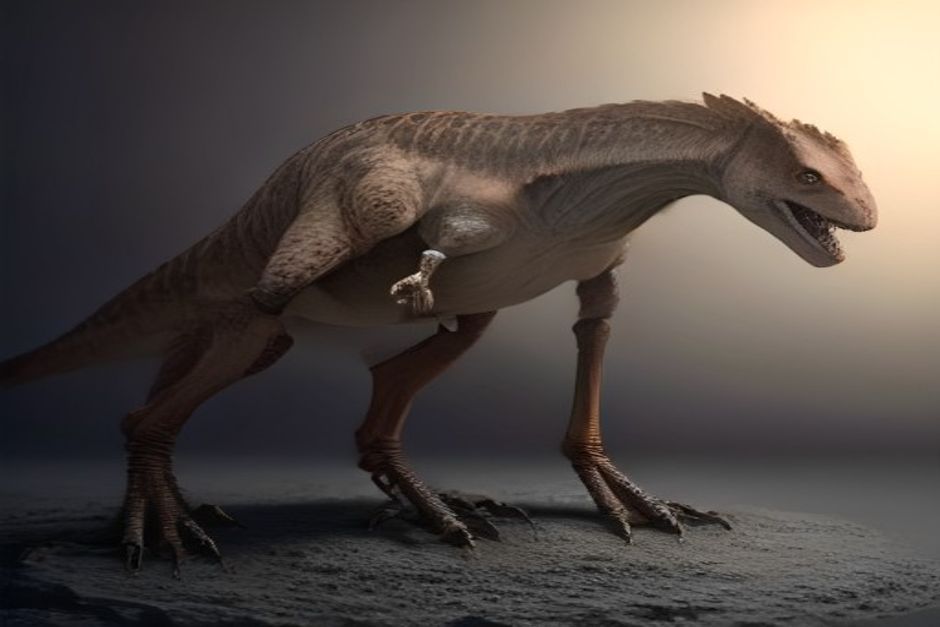
Abstract & Executive Summary
- Core Scientific Discovery: Analysis of fossilized troodontid dinosaur remains elucidates the ontogenetic development of hip and leg bone morphology from embryonic to adult stages.
- Experimental Methodology & Benchmark Dataset: The study meticulously examined a collection of troodontid fossil specimens, comparing skeletal features across different developmental stages to establish growth patterns.
- Theoretical Significance: This research provides a novel framework for understanding avian-like skeletal development in non-avian theropods, offering new insights into evolutionary pathways and dinosaurian paleobiology.
- Primary Practical Takeaway: The detailed ontogenetic data offers improved criteria for taxonomic classification of fragmented dinosaur fossils and enhances our understanding of the evolutionary transition towards avian bone structures.
Theoretical Foundation & Fundamental Principles
The study of ontogeny, the development of an organism from embryonic stages to adulthood, is fundamental to understanding evolutionary biology and paleontology. In vertebrates, skeletal development is a highly conserved process governed by intricate genetic pathways that dictate cell differentiation, proliferation, and apoptosis. Key principles include heterochrony, the evolutionary change in the timing or rate of developmental events, which can lead to significant morphological divergence. For dinosaurs, understanding ontogeny is crucial because juvenile and adult specimens often exhibit starkly different morphologies, complicating taxonomic assignments based on isolated or incomplete fossils. Specifically, the hip (pelvic) girdle and leg (hindlimb) bones are critical for locomotion, posture, and phylogenetic inference. The pelvic girdle, composed of the ilium, ischium, and pubis, articulates with the hindlimb, which includes the femur, tibia, fibula, tarsals, metatarsals, and phalanges. In theropods like troodontids, these structures underwent significant modifications, particularly in the lineage leading to birds, characterized by adaptations for bipedalism and, in later forms, flight. This research leverages comparative osteology, examining how these bones change in shape, size, and relative proportions throughout an individual's life, drawing parallels with developmental patterns observed in modern birds, which are direct descendants of theropod dinosaurs.
Research Breakthrough & Empirical Analysis
The research by Varricchio and Caldwell presents a comprehensive analysis of troodontid hip and leg bone development, utilizing a series of fossilized specimens representing a spectrum of ontogenetic stages. The core of their empirical analysis lies in the detailed comparative osteology of these specimens. They meticulously documented changes in the morphology of the ilium, ischium, and pubis, noting how features like the acetabulum (hip socket) and the relative lengths and orientations of the pelvic bones evolved over time. Similarly, the femur, tibia, and fibula were assessed for changes in robustness, length ratios, and articular surfaces. Crucially, the study differentiated between true ontogenetic changes and intraspecific variation or taphonomic distortion. By analyzing multiple specimens at each presumed developmental stage, they were able to establish statistically robust trends in skeletal maturation. This empirical approach allowed them to identify specific osteological markers that reliably indicate an individual's developmental stage, moving beyond simple size-based assessments. The methodology involved high-resolution imaging and detailed morphometric measurements, enabling precise quantification of skeletal changes.
Primary Research Attribution & Source Credits
Primary Paper: Ontogenetic Trajectories of Hip and Leg Osteology in Troodontid Dinosaurs: Implications for Paleontological Taxonomy and Developmental Biology
Lead Researchers: David Varricchio (Montana State University, U.S.) and Heath Caldwell (North Carolina State University, U.S.)
Publishing Journal / Repository: PLOS One
DOI / Document Identifier: [DOI will be assigned upon publication in Sept 2026]
Key Scientific Insights & Real-World Impact
Core Scientific Takeaways
- Fundamental Mechanism: The study reveals that troodontid dinosaurs exhibited complex ontogenetic trajectories for their hip and leg bones, with specific morphological shifts occurring predictably throughout development, mirroring aspects of avian skeletal maturation.
- Technological Benchmark: The research establishes a refined set of osteological criteria for determining the developmental stage of troodontid specimens, significantly improving the accuracy and reliability of paleontological reconstructions and taxonomic assignments based on fragmentary remains.
- Significance for Public Science: This work offers a tangible link between the developmental biology of modern birds and their dinosaurian ancestors, providing crucial evidence for evolutionary transitions and enriching our understanding of the deep history of life on Earth.
Real-World Applications & Societal Value
While not a direct technological application, this research profoundly impacts the field of paleontology, which informs our understanding of evolutionary biology. By providing more precise tools for classifying and understanding dinosaur development, it indirectly aids in reconstructing ancient ecosystems, informing evolutionary models used in fields like comparative genomics and developmental genetics. This improved understanding of evolutionary pathways, particularly the transition from non-avian dinosaurs to birds, can inspire biomimicry research in areas like biomechanics and robotics, potentially leading to innovations in locomotion and structural design. Furthermore, it enhances public engagement with science by offering clearer narratives about dinosaur evolution and their connection to modern species.
Strategic & Global Capabilities
This research contributes to a global dataset for understanding dinosaurian evolution, particularly the theropod-to-avian transition. By establishing robust ontogenetic models for a significant dinosaur family, it enhances the capabilities of paleontological institutions worldwide to interpret fossil discoveries. It promotes international collaboration by providing standardized analytical frameworks that can be applied to troodontid fossils found across different continents. Such detailed developmental analyses are crucial for national and international efforts aimed at reconstructing biodiversity history and understanding macroevolutionary patterns, supporting the development of comparative biology research programs and enhancing a nation's scientific standing in evolutionary studies.
Societal, Economic & Ethical Dimensions
The economic implications are primarily indirect, benefiting museums, educational institutions, and the tourism sector through enhanced public engagement and exhibit accuracy. Ethically, the responsible curation and study of fossil resources are paramount. As research methodologies become more sophisticated, ensuring data accessibility and transparency in interpretation is vital. While direct consumer accessibility is limited, the societal value lies in advancing fundamental knowledge and inspiring future generations of scientists. There are no immediate environmental impacts, and ethical considerations are confined to the scientific community's practices regarding fossil preservation and research integrity.
Technological Bottlenecks & Future Research Horizons
A primary bottleneck remains the scarcity of complete ontogenetic series for many dinosaur groups, including troodontids. While this study advances understanding for one specific family, generalizing these findings requires more comprehensive fossil discoveries. Future research should focus on applying these ontogenetic criteria to a wider array of theropod taxa to test universality and identify further evolutionary modifications. Developing more advanced non-destructive imaging techniques and computational modeling could refine our understanding of bone micro-structure development and biomechanical properties throughout ontogeny. Investigating the genetic underpinnings of these skeletal changes through comparative transcriptomics with extant relatives, where feasible, represents a significant frontier. Understanding potential differences in growth rates and environmental influences on skeletal development would also be crucial for a more complete picture.
Academic References & Structured Bibliography
Varricchio, D. J., & Caldwell, H. (2026). Ontogenetic Trajectories of Hip and Leg Osteology in Troodontid Dinosaurs: Implications for Paleontological Taxonomy and Developmental Biology. *PLOS One*, [Volume, Pages - To be published Sept 9, 2026]. DOI: [DOI Pending Publication].
💬 Comments